
Innovations in Decolonising the Curriculum: New book moves beyond debate to action
A new book edited by a collective of UK higher education academics and postgraduates provides a definitive resource on decolonising the curriculum as a rigorous, practical and multidisciplinary process now being implemented across the higher education sector.
Led by Professor Adeela ahmed Shafi from University of Gloucestershire, and co-edited by Dr Anamika Twyman-Ghoshal (Brunel University of London), Dr Acheampong Charles Afriyie, Samuel Robert Copland and Dr Omar El Masri (all University of Gloucestershire), Innovations in Decolonising the Curriculum: Multidisciplinary Perspectives moves beyond theory to provide practical, real-world examples of how to challenge the pervasive influence of colonial paradigms that continue to shape UK universities.
Being released on 12 December, Innovations in Decolonising the Curriculum: Multidisciplinary Perspectives contends that as the UK’s higher education sector faces a profound crisis of funding and relevance, challenging the influence of Western and Eurocentric paradigms is an essential step toward building institutions that are far more valuable to the public good.
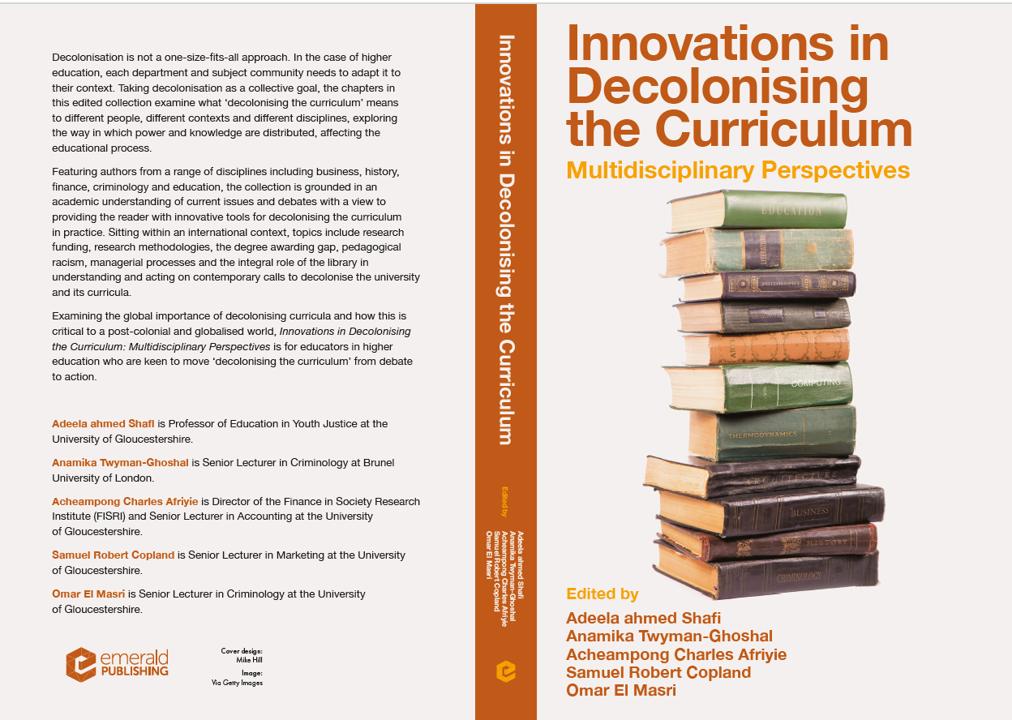
The collection highlights innovative grassroots efforts and offers concrete tools for educators from diverse disciplines, including architecture, business, biology, computer science, criminology, education, finance, history, international relations, literature, physics, and visual arts.
Focusing on action over debate, the book examines key practical topics including curricular design, classroom arrangements, impactful assessments, library support, pedagogical inequality, restorative practices, research funding, research methodologies, and the degree awarding gap.
It provides tangible case studies of how universities can and are unsettling traditional, colonial-era foundations of knowledge.
A key strength of the book is its remarkable multidisciplinary scope. It gathers case studies from across the academy, including Physics, Biology, Computing, Architecture, Business, International Relations, Criminology, History and Illustration.
Lead editor, Professor Adeela ahmed Shafi, said: “This book is a direct response to the urgent need to move beyond slogans and show what decolonising actually looks like in practice.
“This is not about erasing history. It is a rigorous academic process that confronts the colonial underpinnings of knowledge generation, interrogates why Western paradigms have historically dominated academic discourse, and explores how we can actively incorporate diverse epistemologies.
“This work makes our understanding of all subjects – from physics to criminology – more complete, honest, and fit for purpose.”
The book, which includes a foreword by Dr Marlon Lee Moncrieffe, President of the British Educational Research Association (2024–2026), is described as a “significant and timely contribution to the field.”
In his foreword, Dr Moncrieffe writes: “This book advances a powerful argument: that a curriculum grounded in multiple epistemologies… is far more valuable to the public good than one that clings to an outdated, Eurocentric worldview.”
The editors argue this work is essential for confronting structural inequities in higher education, such as the persistent ethnicity awarding gap, and for challenging university leadership to move beyond superficial diversity initiatives.
Innovations in Decolonising the Curriculum: Multidisciplinary Perspectives is published by Emerald Publishing on 12 December 2025.
Main image: The authors of Innovations in Decolonising the Curriculum: Multidisciplinary Perspectives; left to right, Acheampong Charles Afriyie, Professor Adeela ahmed Shafi, Dr Omar El Masri, Dr Anamika Twyman-Ghoshal, Samuel Robert Copland
; ?> "Visit the homepage")