
Source: www.glos.ac.uk. All Rights Reserved. 2026 University of Gloucestershire
Students who have declared to us a medical condition, disability, neurodiversity or learning need that may require reasonable adjustments in placement are encouraged to utilise a Health Abilities Passport (HAP) for their placements. This is a document owned by the student, created with university staff and monitored by the coaches in practice (CIPs).
The HAP contains confidential information regarding the student and therefore consent to share this document lies with them. The CIPs can then support the discussion and implementation of it in practice with the students consent.
When a students allocation comes through to you on ARC, there should be a red flag detailing that the student has an ‘access plan’ – it will not link or detail anything further but is there as a prompt. We advise that it is good practice to ask all students at the start of placement if they have a HAP/additional needs or reasonable adjustments.
The student will identify the nature of their need as below:
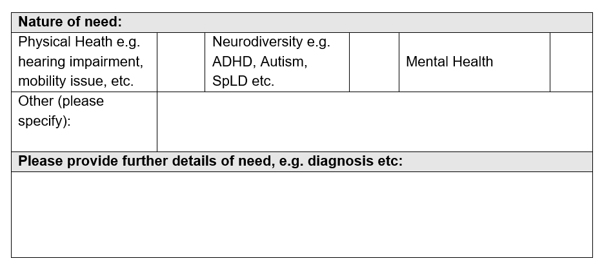
Our practice-based learning lead will then work with the student to identify their strengths and challenges within placement. They will then document any further necessary information, and recommendations from occupational health and other healthcare professionals. The student is also asked to consider what adjustments they feel would benefit them:
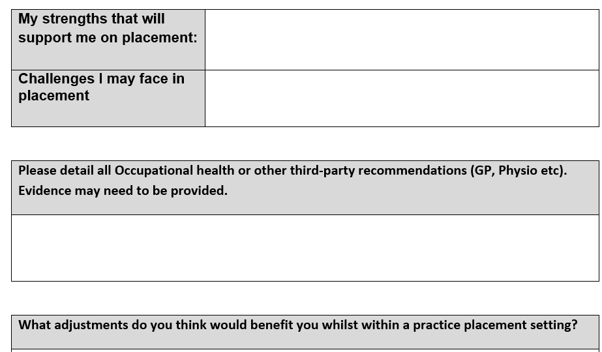
The Practice-based Learning Lead will then detail recommended reasonable adjustments for consideration in a placement setting. We appreciate that not all placements are the same and what may be reasonable in one area may not be feasible in another.
Therefore our Coaches in Practice are available to review the HAP prior to future placements, and amend the adjustments if the environment or adjustments need further consideration.
The HAP may be shared with placement in different ways:
Reasonable adjustments may be quite generic and able to apply to all placement areas, or could be quite specific to a certain environment, so this is a document that will be reviewed and amended as necessary.
Examples of some reasonable adjustments you may see detailed in the HAP are below:
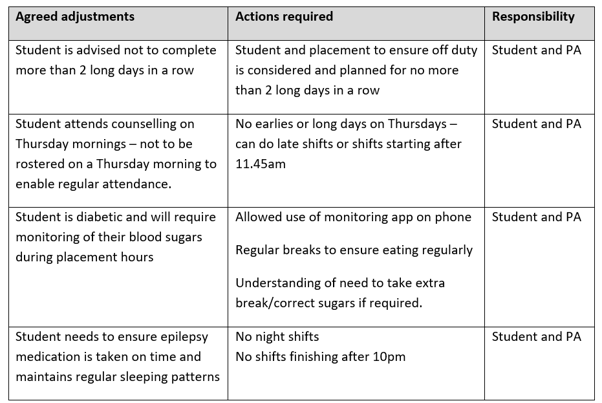
If a Practice assessor/placement staff review a HAP and are concerned that they cannot meet the needs of the student or wish to discuss or revise any of the recommended reasonable adjustments, the Coaches in Practice are available to discuss on teams or come into placement to facilitate further discussion as necessary.
Placements staff may also want to discuss the HAP with their PEF for further advice – please ensure that you have gained the students consent prior to sharing.
For more complex medical requirements, we may need a meeting with placement, CIP and PEF, but most of the time a student will come with their HAP ready to share, and a discussion between student and PA is enough.
If a PA or student would like to discuss the HAP further the CIPs can be contacted on a shared inbox: [email protected].