Meet the lecturer
Your journey to join Team Glos starts with an online…

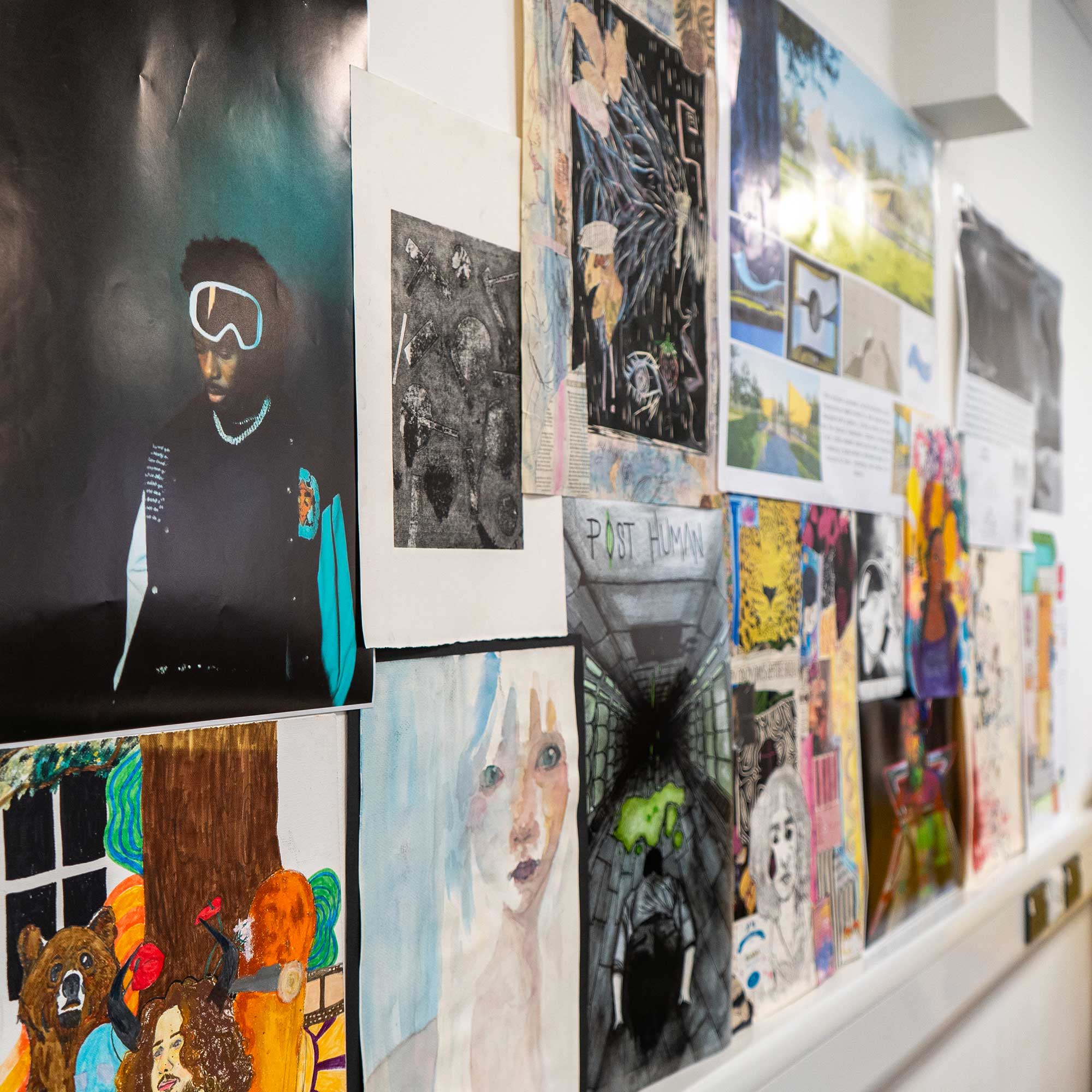
Many of our courses within the School of Arts, Culture and Environment require a portfolio as part of the course application. This page outlines what you need to know.
Many of our courses require a digital portfolio. Portfolios are all about potential. We know you may not be the finished article – we are just looking for you to demonstrate your creative skills and interests. It could be some of your coursework from your current studies or a piece of creative work done in your spare time.
Your portfolio does not need to fit the exact course you are applying for – it is a chance to demonstrate your talent and creative passion. Each course has its own requirements for their portfolios which you can find below.
An academic will go through your portfolio and give you one-to-one, personalised feedback at your Meet the Lecturer online chat. These chats last up to 30 minutes and are hosted on Microsoft Teams.
Your portfolio must be sent in a digital format. Any images of work which is not in a digital format needs to be photographed or scanned to be included. The link must not be password protected and should be available for anyone to view. There should also be no date restrictions for access.
Please send one link to your portfolio. This could be a portfolio using a PDF format or a link to YouTube, Flickr or your own portfolio website. It could also be a link using a file sharing platform such as Google Drive.
Any questions around your portfolio submission, please email [email protected]
Portfolios are only required for the following courses. Requirements vary depending on the course you are applying for – refer to the list below for details.
Jump to: Animation | Architecture | Art and Design | Film & TV | Games | Illustration | Performing Arts | Photography | Sound and music
Your portfolio can include drawings, photographs, paintings, comic strips and storyboards, character designs and sketchbook page scans. Anything to show a passion for the art of animation and art. Sample animation is good but not essential.
We welcome portfolios showing any kind of creative interests and skills – limited to 12 pages.
Landscape architecture is a wide-ranging creative profession which combines design with the environment, and art with science. In that respect we are interested in seeing a portfolio of work which can take different forms and we are open and keen to see creative interpretations of your interests across the full range of art, design and science-based subjects which underpin the landscape profession. We are looking for evidence of your artistic, creative, craft and technical interests as well as your reflective skills.
We would expect to see a considered selection of about 12 pieces of work created by you whilst studying on your current or past art-based courses, or it could be any art and design work related to personal hobbies or interests that you may have. Your portfolio should showcase your range of skills and techniques from concept development, through preparatory pieces and final completed work. For the Meet the Lecturer Session, we would be particularly keen to see physical sketchbooks that represent your techniques and processes.
Your portfolio should give us an idea of what you are interested in outside of Art. Let us know what exhibitions you have seen recently, and what you like making.
We welcome portfolios that demonstrate a wide range of creative interests, skills and experiences. Your portfolio does not need to focus solely on graphic design and we encourage you to include work that reflects your individual interests, ideas and creativity. Portfolios should be limited to a maximum of 10 pages.
Interior Design is an incredibly broad discipline, and so we’re interested in seeing examples of your work, and your passion for creating interior spaces. Some examples of portfolio work can include ‘making’ of any kind; textile designs, sewing skills, embroidery, printmaking, watercolours, drawing, photography, model-making. These examples may be based on analogue or digital techniques, and in any medium – so for example ‘drawing’ might include sketches of spaces and places, observational drawing, conceptual drawing, or technical drawing.
We would expect to see around 12 pieces of work, preferably in sketchbook form, along with some reflective notes (for example, artists or designers that you may have studied, interiors that inspire you, spaces that you have visited).
The purpose of your portfolio is to give us an example of your creativity – whatever that might be. So for example, a PDF with a link to a showreel or film, or a selection of drawings, photographs or creative writing. Your portfolio folder should provide us a sense of your creative self.
Your portfolio should include examples of sound and music work in a format that can be viewed via Microsoft Teams. This might include video of games you have made, animation, illustration and art images. and 3D work.
Work can come from school, college, personal projects, collaborative work, or independent creative practice. Finished pieces are welcome, but we are equally interested in hearing works in progress, sketches, experiments, and ideas that show how you approach the creative process. We are keen to see anything that demonstrates your creative interests and current skillset.
A portfolio is not required for the following courses:
We would like to see a wide selection of your work. This should include personal sketchbooks, experiments and developmental work, as well as final outcomes. Bring the work you love best. What do you like to do most of all and how does that connect to your goals as an artist? Worry less about getting it exactly ‘right’ and think instead about what pieces can show us the most about who you are and what you want to do next. That’s why sometimes work in progress is more useful than final pieces.
Your portfolio should be between 10-15 pieces or projects. Think about how you order your work. Where should your best pieces go? Which is the best one to start with? You can tell the story of who you are as an artist, what your interests are, what direction you want to go in, and how you think about your work. Final pieces, work in progress, research and sketchbooks can all be a part of a successful portfolio.
The following courses require an audition at your Experience Day. No portfolio is required.
Please share a portfolio of your creative photography. We’re really interested in seeing your personal work, as well as work created for a previous qualification (if you are doing or have completed one). You can include videos and related art and design work.
If you have previously created a sketch/research books, please include a couple of pages so we can see research and development you have carried out.
Your folio should be limited to 30 pieces in total.
Please share a URL to a website you have created or another image sharing platform such as Instagram, or a PDF of your folio.
Please share a portfolio of your creative photography. We’re really interested in seeing your personal work, as well as work created for a previous qualification (if you are doing or have completed one). You can include videos and related art and design work.
If you have previously created a sketch/research books, please include a couple of pages so we can see research and development you have carried out.
Your folio should be limited to 30 pieces in total.
Please share a URL to a website you have created or another image sharing platform such as Instagram, or a PDF of your folio.
Please share a portfolio of your creative photography. We’re really interested in seeing your personal work, as well as work created for a previous qualification (if you are doing or have completed one). You can include videos and related art and design work.
If you have previously created a sketch/research books, please include a couple of pages so we can see research and development you have carried out.
Your folio should be limited to 30 pieces in total.
Please share a URL to a website you have created or another image sharing platform such as Instagram, or a PDF of your folio.
Please submit a short video (3–5 minutes) of you singing or playing an instrument of your choice. This can be a cover or an original song, recorded especially for your application or taken from a previous performance. Solo and group performances are welcome. If you submit a group performance, please identify yourself and your role.
You are also welcome to share other examples of your musical and creative work, such as original songs, recordings, demos, lyrics or music videos. These can come from school, college, personal projects or collaborations. Finished pieces and works in progress are equally welcome.
We welcome all genres and styles, and applicants with different musical backgrounds and strengths. Your portfolio should give us a sense of your interests, your current musical skills and the work you enjoy making. A simple phone recording is fine – professional recording equipment is not required.
Please share your work through accessible links, such as YouTube, SoundCloud or a cloud storage service. Check that the links work without requesting access, and briefly explain your contribution to any collaborative work.
Your portfolio should include examples of sound and music work in the form of audio and/or video files and can cover any aspect of audio production.
This might include tracks, performances, recordings, sound design, compositions, live sound projects, or any other work that demonstrates your interest and experience in creating audio.
Work can come from school, college, personal projects, collaborative work, or independent creative practice. Finished pieces are welcome, but we are equally interested in hearing works in progress, sketches, experiments, and ideas that show how you approach the creative process.
We are keen to see and hear anything that demonstrates your ability to capture, create, manipulate, and present sound. Files can be shared via cloud transfer services or through platforms such as YouTube, SoundCloud, or similar online services.
A portfolio is not required for the following course: