City Campus
City Campus is our exciting new campus due to open…

Viewing entry requirements and fees for: . Change course option

95% of our graduates are in work or further study*
If you’re not in a job 6 months after graduating, we’ll guarantee you 6 months of free support, followed by the offer of a paid internship. Plus, we’ll commit to lifetime career coaching. Eligibility conditions apply.
*Graduate outcomes Survey 2024 and based on 2021/22 leavers
In your second year you’ll have the opportunity to gain professional experience by doing a mini placement, either with an outside organisation or with one of our staff members.
In addition, students have the option to complete a full placement year between their second and third years. Those who choose this route are supported during their second year in identifying, applying for, and preparing for a suitable placement, helping to develop relevant skills and professional experience.
We have links with many external organisations working with offenders and victims of crime, such as prisons, Victim Support and Circles South West.
At the beginning of the academic year, the Student Futures teams organises an opportunities fair, where relevant organisations come to talk about the placement opportunities they offer.

In your first year, you’ll have the opportunity to go on a field trip to a community farm and mental health museum. We’ll consider how mental health and treatment has changed over time, from the restricted structure of the asylums to modern initiatives designed to encourage independence and wellbeing.
In your second year you’ll visit a prison museum, such as Shepton Mallet prison. These are prisons that used to be working prisons but have closed in the last few years. This trip will allow you to feel what it is like to be inside a prison and the challenges of being a prison psychologist.

Throughout the degree you’ll have the opportunity to take part in away days and events. From writing workshops to poster days, these activities give you a chance to bond with your fellow students and build your confidence in your own work.
We also regularly organise panels with external speakers, such as alumni and careers panels. Alumni panels are an opportunity to meet students that have already graduated and to hear about their journey after graduation. Careers panels are an opportunity to hear the top tips from professionals working in different areas of the criminal justice system.

Receive news of upcoming events and information about life at UoG.

Book your place at an open day or campus visit to get a feel for UoG.

Our step-by-step guide to the application process.
Based at our City Campus the immersive room allows students to immerse themselves in different settings, including crime scenes and consultation rooms.
There’s also the opportunity to have a close look at the structure of the brain using the immersive technology.
Eye tracking glasses are used to study perception in different situations. You’ll use them in crime simulations to understand what different witnesses pay attention to, and therefore are more likely to remember.

An electroencephalogram (EEG) is a painless brain scan that measures electrical activity in the brain. This can be used to identify how different people react to different stimuli.
It can be used to identify how people with different conditions, such as psychopathy, react to watching a violent scene.

Based at Oxstalls, our Moot Court has everything needed to look like a real court room. This facility allows you to practise how to give expert evidence in a court environment.

We have several types of virtual reality headsets at your disposal, and the new City Campus features a state-of-the-art immersive virtual reality room.
Virtual reality could be used to simulate different conditions, such as being a witness of a crime or being sent to prison.

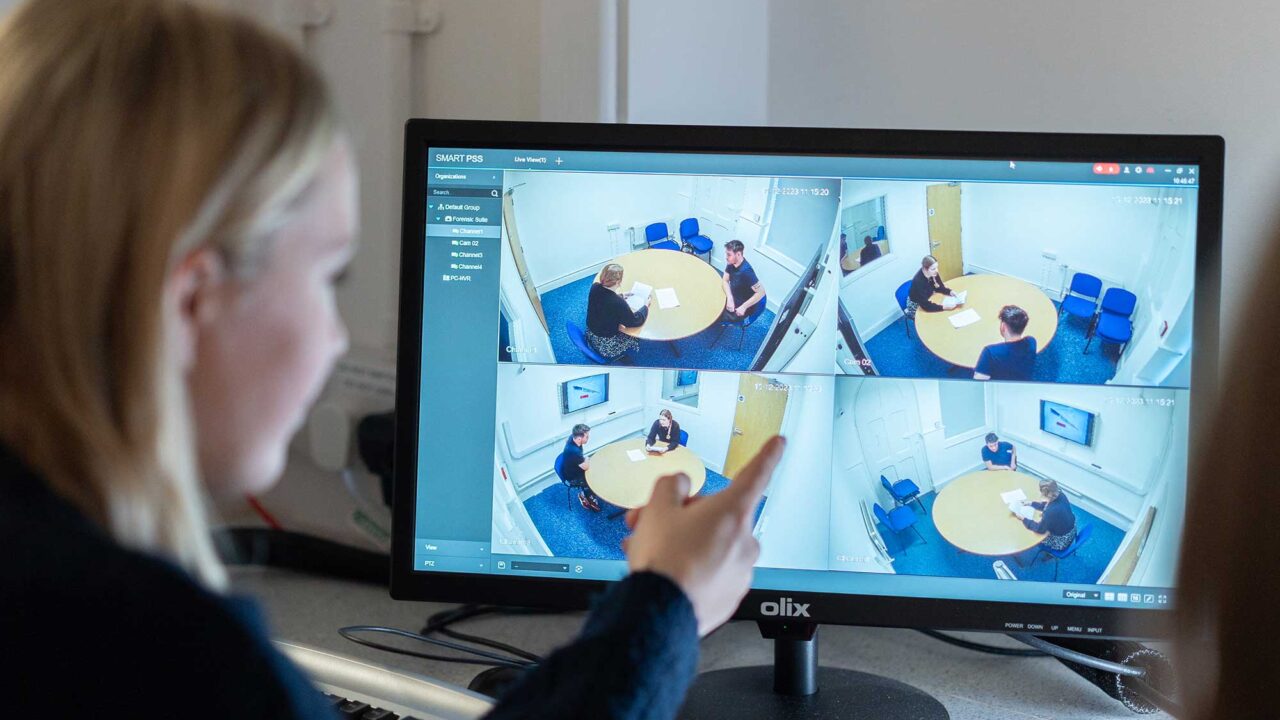
Based at Francis Close Hall, the forensic interviewing suite allows students to practise and observe investigative interviews, a basic skill in criminal investigations.
The suite features a one-way mirror, cameras and microphones.

Discover stories from our students and graduates.
Our Forensic Psychology degree is BPS accredited, meaning it will give you graduate basis for membership – the first step to becoming a chartered and registered practitioner psychologist.

Pact is a national charity that supports prisoners, people with convictions and their families. Pact attends the annual Opportunities Fair where students can find out more about employment opportunities.
Victim Support is an independent charity dedicated to supporting victims of crime and traumatic incidents in England and Wales. Victim Support attends the annual Opportunities Fair where students can find out more about employment opportunities.
CCP (Caring for Communities and People) is a Cheltenham-based charity which aims to prevent the causes and reduce the effects of homelessness, family breakdown and exclusion. CCP attends the annual Opportunities Fair where students can find out more about employment opportunities.
University isn’t all about studying, it’s important to make the most of student life and have fun too.
There’s lots going on outside of lectures for you to get involved in, from sports to societies in our Students’ Union.
Varsity takes place each year against local rivals University of Worcester, it’s easy to get involved – you can compete, coach or support UoG.
With 500 bars, clubs and pubs, plus easy access to beautiful countryside, Gloucestershire is a vibrant county with lots happening across Cheltenham and Gloucester.

In your Forensic Psychology modules, you will be taught by lecturers with work experience in varied parts of the criminal justice system. Among our staff, we have former probation officers, as well as active forensic psychologists working part-time as lecturers.
In modules combined with Psychology, you’ll meet a range of academics with varied experience and expertise across different areas of psychology, such as social and cognitive psychology.
Fill in the form below and we’ll be in touch with course updates, upcoming events and everything you need to know about university life.
; ?> "Visit the homepage")

