Please note: applications for all our PGCE course close at 5pm on Friday 31 July. To discuss your application after this date, contact the Admissions Team by email: [email protected].
Chemistry is one of three specialist PGCE Secondary Science courses offered at University of Gloucestershire, alongside Biology and Physics, designed to prepare you to inspire the next generation of scientists.
Science teachers help unlock the world for young people, from all backgrounds, by encouraging wonder and enquiry about the natural and engineered world around them (and beyond) and help them to understand the complex, abstract and often beautiful processes that have shaped it, as well as the challenges it now faces in relation to resources, energy, environmental impact and communication. On UoG’s PGCE Science programme, you will become part of that mission: inspiring curiosity, sparking debate, and helping pupils to appreciate their potential impact on an ever-changing natural and technological world.
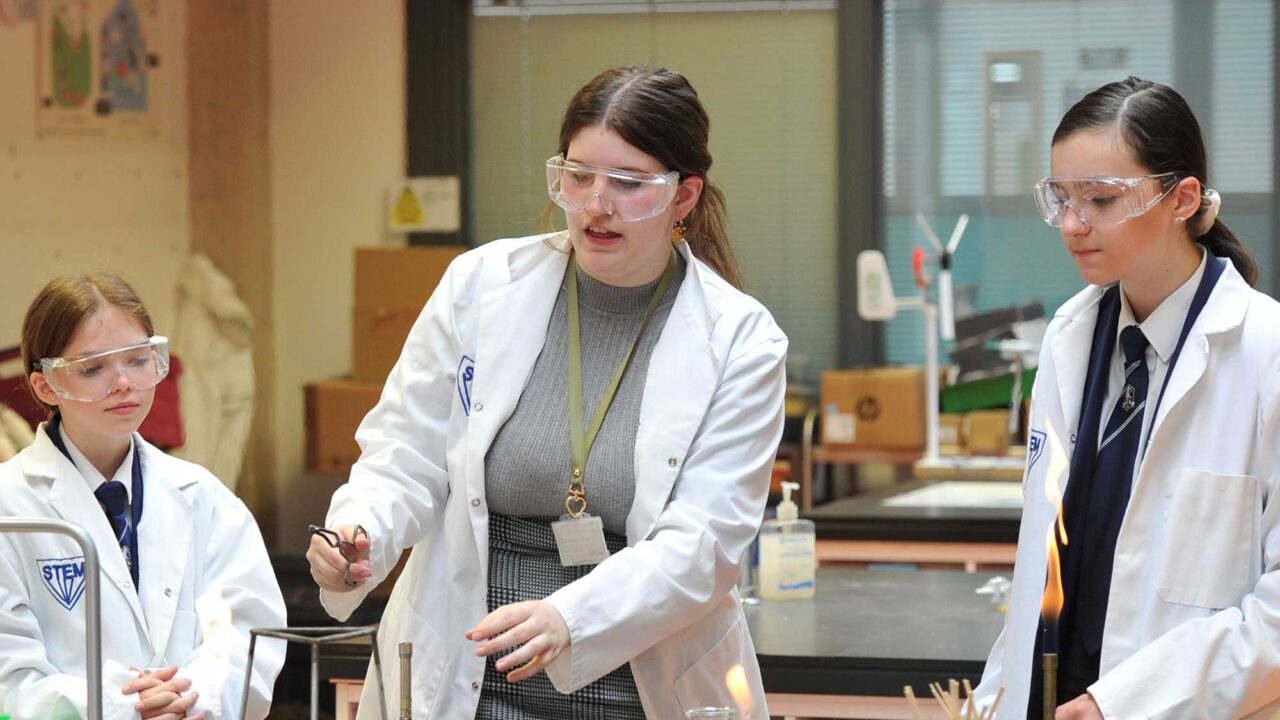
Our course is designed to turn your passion into powerful teaching. You’ll learn how to think, plan and teach science, building both your subject knowledge and your ability to bring it to life in a safe but challenging classroom environment. Through enquiry, debate, experimental work, outdoor learning and real-world contexts, you will develop lessons through which learners will not just recall but will feel engaged, challenged and inspired.
Subject sessions will take part in a laboratory on campus, or classrooms in our lead partner schools, to allow you to observe authentic classroom teaching skills and actively explore and trial common Enquiry Types. Sessions will be led by science specialist tutors, exploring current and contemporary debates about the nature of learning and teaching science. Grounded in research and shaped by leading organisations including the Education Endowment Foundation, the Association for Science Education, STEM learning, the Royal Societies for Chemistry and Biology and the Institute of Physics, the course helps you understand why great teaching works as well as how to do it. You will learn to sequence knowledge, challenge and support all learners and create meaningful scientific experiences that go beyond the classroom.
By the end, you will be more than a teacher, you will be a science specialist who can inspire curiosity, build understanding and make a real difference to both young people and the planet.
Study style
The course is split into 3 phases which allow trainee teachers to gain knowledge and learn skills related to their teaching practice. Developing – From September Broadening – From January Enhancing – From April
During the Developing phase of the curriculum, trainees will attend university-based lectures and be introduced to the following Curriculum Key Themes:
Behaviour Management and High Expectations
Subject Knowledge and Curriculum Design
Adaptive Practice and Inclusion
Children’s Learning, Classroom Practice
Assessment
Professional and Ethical Practice.
During the Developing phase, trainee teachers experience their first Intensive Training and Practice (ITaP) which is focused on behaviour. Here, from week 3 of the course, trainee teachers gain experience in one of our Lead Partner Schools exploring how classroom routines and use of behaviour policies support effective learning.
Trainee teachers get practical experience delivering sessions and receiving feedback in order to feel prepared for their first school placement in October.
During school-based training, trainees will revisit specific Curriculum Key Themes and attend university-based training sessions to support and develop their teaching practice.
During the Broadening phase, trainees will build upon and extend the knowledge and skills gained from school experiences and the university-based taught programme. Trainees will be expected to revisit and broaden their knowledge and practice of the 5 curriculum areas and Curriculum Key Themes introduced at the Developing Phase, and will engage with new Curriculum Key Themes, such as:
Curriculum Design
Subject Knowledge
Sustainability
Employability
Research Informed Practice
In addition, trainees will take part in their second ITaP with a focus on adaptive practice. All trainees will gain experience in an SEND school and explore how to support and challenge all learners in their subject.
During this phase of the curriculum, trainees will be supported to take on wider responsibilities as a part of the role of a trainee teacher and have opportunities to discuss, analyse and observe expert colleagues to support their progression through the Broadening Phase.
Trainees will broaden their knowledge and experience of decolonising the curriculum, sustainability for education and other contemporary issues in education.
During the Enhancing phase, trainees will enhance and extend the knowledge, skills and experience gained previously. During the Enhancing Phase, trainees will be expected to revisit and extend their knowledge and practice of all 5 curriculum areas:
Behaviour Management
Pedagogy
Curriculum
Assessment
Professional Behaviours
During this phase trainees will take part in their final ITaP with a focus on assessment, as well as developing a greater understanding of the KS2 and KS5 curriculum for their subject and taking part in a ‘Learning outside the classroom’ enhancement project.
At the end of the secondary programme, our highly employable trainees will be able to further enhance their professional development and draw upon the skills gained throughout the course to become:
Graduate Ambassadors of Education
Leaders of Learning
Outstanding Teachers
Subject Experts
It’s planned that this course will be taught at UoG’s new campus in Gloucester city centre from September 2025.
The vibrant campus will be at the heart of the regeneration of Gloucester city centre. It will bring an iconic building back to life as a modern centre for teaching, learning and community partnerships, through placements, research and outreach activity, and provide cutting-edge facilities for your course.
Privacy NoticeBy clicking play, you agree to load content from YouTube, which may collect data about your visit. YouTube's privacy policy applies.
Get Secondary Education Chemistry PGCE course updates and hear more about studying with us.
An honours degree, normally at 2.2 or above (or equivalent) in a relevant subject.
If you do not hold a 2.2 or above, we may be able to consider your application but will require additional information.
If you do not hold a degree in a relevant subject we will be able to consider your application if you have other qualifications, such as A Levels or postgraduate qualifications in the subject.
GCSE English Language and Mathematics at grade 4 (C) or above, or an equivalent qualification.
If you don’t have a traditional GCSE, get in touch with our admissions team who will be able to advise you.
If you are offered a place on the programme you will be required to complete a health declaration, which will be assessed by the University Doctor.
The University of Gloucestershire is committed to safeguarding and promoting the welfare of children and expects all our trainees to share this commitment.
If you are offered a place it will be subject to:
Satisfactory Safeguarding checks including the receipt of a ‘satisfactory’ Enhanced DBS return including children’s barred list information
Satisfactory completion of suitability form
Verification of two references
Satisfactory Certificate of Good conduct, where applicable, for those who have lived or worked abroad
Here's an example of the types of modules you'll study (the contents and structure of the course are reviewed occasionally, but it is unlikely that there will be significant change).
Module information is not available for this programme.
A bursary of £29,000 is available for trainees starting this course in September 2026. Postgraduate bursaries are tax-free payments you receive if you're training to teach certain subjects. You do not need to apply for a bursary, you'll automatically get one if you're eligible. To find out more, including other scholarships and bursaries available, visit the Get into Teaching website.
UoG graduates receive up to 15% off postgraduate tuition fees. Terms apply.
Start date
Location
Course code
Fee (UK) Fee per year
Fee (international)
Fee per year
Sep 2027
City Campus, Gloucester
R732
TBC
TBC
Sep 2028
City Campus, Gloucester
R732
TBC
TBC
International students can benefit from a range of scholarships and bursaries across many undergraduate and postgraduate programmes.
At UoG we create a climate for bravery and growth. We instil confidence in all our students, so you can graduate career-ready and meet your ambitions.
94% of our graduates are in work or further study*, but if you’re not in a job 6 months after graduating we’ll guarantee you 6 months of free support, followed by the offer of a paid internship to kickstart your career – plus we’ll commit to lifetime career coaching. Eligibility conditions apply.
*Graduate Outcomes Survey published 2026 and based on 2023/24 leavers
Discover our promises
Careers
Our vision is for all of our students to become graduate ambassadors for education, leaders of learning, outstanding teachers and subject experts.
Employment rates have been consistently high for graduates and we offer you the opportunity to gain Master’s credits which count towards a full Master’s degree. This can be used to take your career in secondary education to the next level at a subsequent time.
All students undertake Master’s level modules in addition to other compulsory modules. If you pass all elements of the course at Master’s level, the award title will carry Master’s credits and QTS.
Work with leading practitioners, coaches, and professionals in specialist environments where you’ll develop your skills and and make a difference to people’s lives.
Fill in the form below and we'll be in touch with Secondary Education Chemistry PGCE updates, upcoming events and everything you need to know about university life.