
Source: www.glos.ac.uk. All Rights Reserved. 2026 University of Gloucestershire
When you apply for a Student visa, you may need to show that you have enough money to pay your outstanding tuition fees and support yourself while you study in the UK. UK Visas and Immigration (UKVI) calls this the ‘financial requirements’.
If you are eligible to bring your partner or children with you as dependants, you may also need to show you have additional money for their living costs.
Getting the financial requirement wrong can result in your visa application being refused, so it is important to understand how much money you need, where the money can be held, and how long you need to hold it before applying.
The University of Gloucestershire is outside London. You therefore need to use the outside London living-costs when calculating figures explained on this page.
If you are applying from outside the UK for entry clearance, or if you have been living in the UK with immigration permission for less than 12 months, you must meet the financial requirements for the following:
If you are from an exempt country, you do not need to submit any evidence of funds with your visa application, but you should prepare the evidence nonetheless, since UKVI may ask to see it.
You must have sufficient funds to pay for any outstanding tuition fees you still owe for the relevant period of study.
If your course lasts more than one year, you would normally only need to show the outstanding tuition fees for the first year of the course, rather than the fees for your entire programme.
Your tuition fees will be shown on your Confirmation of Acceptance for Studies (CAS).
If you are continuing a course that you have already started, your CAS will confirm the fees relevant for the new period of Student permission.
Any advance tuition fees you have already paid to the University can be deducted from the amount you need to show, provided the payment is recorded on your CAS or otherwise evidenced in a way accepted by UKVI. For this reason, it is important that, where possible, you pay the total amount you intend to pay in one payment, and that you inform the University if the amount listed on your CAS statement is incorrect before you submit your visa application. The University is unable to update UKVI with any payments made after your visa application has been submitted.
If you have received a financial bursary or scholarship, you can also deduct this award from the amount you need to show. Awards are similarly recorded on your CAS.
Use the course start and end dates on your CAS to calculate the length of your course and therefore how many months’ living costs you will need.
Note, part of a month counts as a whole month. If your course includes part of a month, you must round up to the next complete month. For example, a course lasting 5 months and 2 days requires 6 months of living costs.
| Length of course | Living costs for you | Living costs for dependants |
|---|---|---|
| 1 month | £1,171 | £680 |
| 2 months | £2,342 | £1,360 |
| 3 months | £3,513 | £2,040 |
| 4 months | £4,684 | £2,720 |
| 5 months | £5,855 | £3,400 |
| 6 months | £7,026 | £4,080 |
| 7 months | £8,197 | £4,760 |
| 8 months | £9,368 | £5,440 |
| 9 months or longer | £10,539 | £6,120 |
UKVI sets a fixed amount that students must have available for their living costs. For study outside London, this is currently £1,171 per month.
You must calculate this for every month of your course, up to a maximum of 9 months.
This means the maximum living cost requirement for you is £10,539.
Can I deduct accommodation payments?
There is a limited concession if you have already paid money to the University for accommodation in halls of residence. You cannot normally deduct payments made for private rented accommodation, private halls, a hotel, Airbnb or other accommodation that is not provided by the University.
You can deduct a maximum of £1,529 from your living cost requirement if:
Even if you have paid several months’ rent in advance, the maximum qualifying deduction is £1,529.
Changes to living costs from 30 November 2026
For Student visa applications made on or after 30 November 2026, the living cost requirement will change.
Students applying to study outside of London will be required to show they have £1,203 per month (up to a maximum of 9 months).
If you have already paid money to the University for accommodation in halls of residence, you can continue to deduct a capped amount of money from the amount you have to show in your application. That capped amount of money will be increasing to £1,570.
Eligibility to bring dependants is a separate Student visa requirement. Not all students are permitted to bring dependants. For further information please visit our dependants webpage.
If you are eligible to bring a partner or children to the UK as Student dependants, you must normally demonstrate additional money for each dependant.
For a Student studying outside London, the current requirement is £680 per month for each dependant, up to a maximum of 9 months.
This means the maximum living cost requirement for each dependant is £6,120.
Use our CAS funds calculator to work out the minimum amount you need to evidence when submitting your CAS request. Our online calculator takes into account your outstanding tuition fees and the living costs you need to show for yourself and any eligible dependants.
If you are using money held in a bank account, two of the most important Student visa financial requirements are the 28-day rule and the 31-day rule.
You must hold the required amount of money in your account for at least 28 days in a row. The financial evidence you use must then be dated no more than 31 days before you submit your Student visa application.
“You must hold the required amount of money in your account for at least 28 days in a row”
Your funds must be held in the account for a minimum of 28 days. The balance should not drop below the required amount on any day of the 28-day period. Only at the end of the 28-day period can you obtain a bank statement showing that the required funds have been held consistently for 28 days.
If the balance drops below the required amount, then the 28-day period will restart, and you will need to wait another 28 days for a statement to be ready.
“The financial evidence you use must then be dated no more than 31 days before you submit your Student visa application”
The end date of the 28-day statement must be no more than 31 days before your visa application submission date. Once you have received your CAS document from the University, you must apply for your Student visa within this 31-day period.
If you do not apply within this period, then you will need to provide a new 28-day bank statement to the University to be checked. You must wait until we have approved the new statement before you can submit your visa application.
As part of the CAS process, we will check and verify your financial evidence to make sure it meets UKVI financial requirements. We will only issue your CAS once we are satisfied that the evidence is acceptable. You should then apply for your Student visa as soon as possible, using the same financial evidence that we have checked and approved. This will help reduce the risk of your visa application being refused because of your finances.
To meet the financial requirement, you must satisfy both rules:
The following examples identify how these two rules may impact potential financial requirement scenarios.
The account balance stays at or above the required amount for the full 28-day period. The Student visa application is then submitted within 31 days of the end of that 28-day period, so the financial evidence meets both rules.
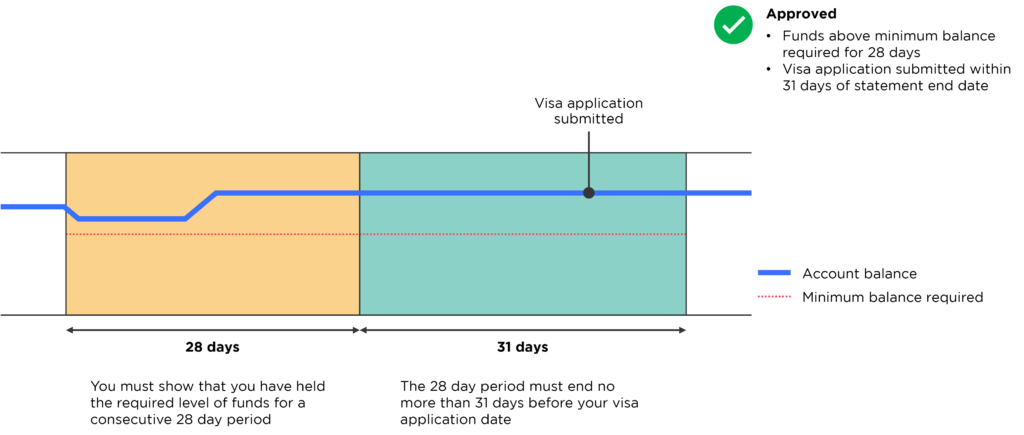
Approved – the funds are held for 28 days and the visa application is made in time.
The required amount must be held continuously for at least 28 days. If the balance drops below the required amount at any point, the 28-day period is broken and you must start counting a new 28-day period from when the full amount is available again.
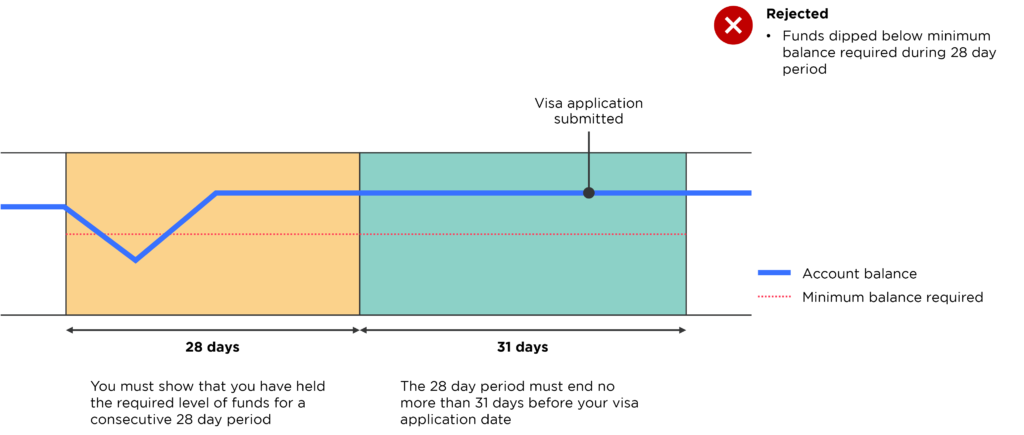
Rejected – the balance falls below the required amount during the 28-day period.
Even though the required amount has been held for 28 days, the visa application must be submitted within 31 days of the end of the 28-day period. In this example, the application is made after the 31-day limit, so the financial evidence can no longer be used.
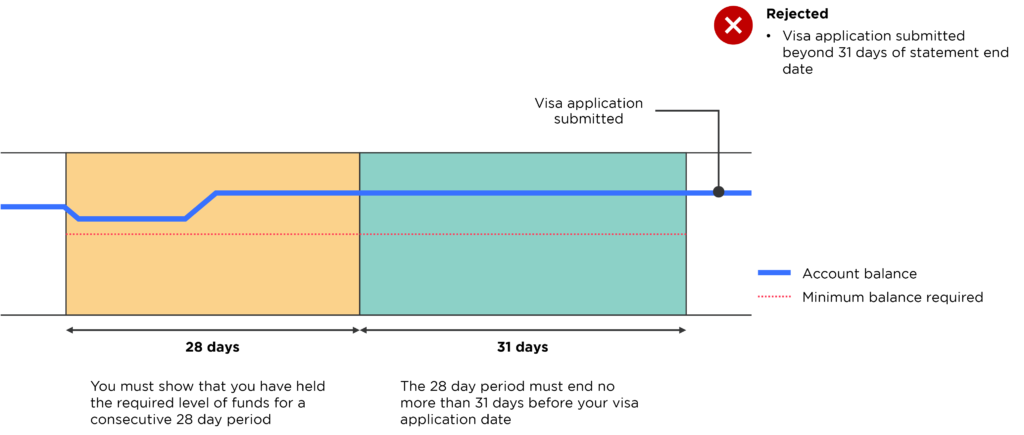
Rejected – the visa application is submitted too late.
You can usually rely on:
You cannot rely on:
The important distinction is that UKVI generally requires accessible cash funds, rather than evidence that you or your family own assets of an equivalent value.
What type of accounts can I use?
Money must be held as accessible cash funds in an acceptable personal bank or building society account.
Examples can include:
The money must be under the control of the permitted account holder and must be available for your use.
The financial institution must also:
UKVI may contact a bank to verify financial evidence. If the evidence cannot be satisfactorily verified, your visa application may be refused.
UKVI are not able to accept financial statements or funds held in a microfinance bank.
What should my bank statement show?
Your financial evidence should clearly show the required information, including:
Bank statements can be paper statements or electronic statements. Electronic bank statements do not automatically need to be stamped by the bank simply because they were downloaded online.
Certificates of Deposit
A Certificate of Deposit can be accepted by UKVI, provided it shows both the following requirements:
Can I evidence my funds using a student loan?
Yes, an eligible Student loan can be used to meet the financial requirement.
The loan must normally be provided by:
The loan must be in your name – loans held in a parent or legal guardian’s name are not acceptable.
Your loan evidence must normally:
A normal personal loan does not automatically qualify as a Student loan for these purposes.
Can I meet some or all of the financial requirement through official financial sponsorship?
Yes. Eligible official sponsorship can include sponsorship from organisations such as:
If you are in receipt of sponsorship from one of these organisations, you will normally need an official sponsorship letter confirming information such as:
If your sponsorship only covers part of the required amount, you will need acceptable evidence that you can fund the remainder.
If your sponsorship covers all your tuition fees and living costs, and your sponsor limits the time that you may study in the UK, UKVI will take the date on the sponsorship letter as the course end-date for visa purposes, irrespective of the actual course end-date stated on your CAS.
Yes, you can use money held across more than one acceptable account to meet the financial requirement. However, the evidence must demonstrate that the combined amount remained at or above the required total throughout the same relevant consecutive 28-day period.
Make sure the statements you use cover a common 28-day period.
Yes, you can use money held in the personal bank account of your parent or legal guardian. However, in addition to appropriate evidence of the funds, you must normally provide:
1. Evidence of your relationship
For example:
A sworn affidavit alone cannot be accepted as evidence of legal guardianship. An affidavit is only evidence that someone has made a sworn statement regarding a claimed relationship, rather than evidence of legal guardianship. You must provide official evidence confirming that the account holder is your legal guardian, such as a court document or other government-issued documentation. You must also provide written consent from your legal guardian confirming that you may use the funds.
Other official evidence may be accepted in countries where the usual documents are not issued.
2. A consent letter
Your parent or legal guardian must provide a signed letter confirming:
A bank statement belonging to another relative (for example, a brother, sister, aunt, uncle or grandparent) cannot normally be used simply because they have written a letter giving you permission to use their money. If another person wants to fund your studies, they will need to transfer the funds into an account that you are permitted to use, allowing sufficient time for the money to meet the 28-day requirement.
Yes, if you are named as one of the account holders, for example, an account jointly held by you and your parent or partner can be acceptable.
Your name should be clearly shown on the evidence.
In certain circumstances, yes.
You may be able to rely on money held in your partner’s account if your partner:
The precise requirements depend on your circumstances, so check the current Student route financial guidance before relying solely on a partner’s account.
Yes, your funds do not need to be held in British pounds (GBP).
If your money is held in another currency, UKVI will normally convert the funds into GBP using the OANDA exchange rate on the date of your visa application. The University will also do this when verifying your funds prior to CAS issuance.
To offset any detrimental exchange rate fluctuation, between the University verifying your funds and your visa application, we advise you include an additional £500 as a ‘buffer’, to offset any drop in your balance. Maintaining a sensible financial buffer reduces the risk that exchange-rate movements cause your funds to fall below the GBP requirement.
Some currencies are not supported by OANDA and it is not possible to use it to obtain a currency conversion. Where OANDA cannot be used for currency conversion, currency should be converted using the Foreign, Commonwealth & Development Office (FCDO) consular rate of exchange (CER). The FCDO CER is set centrally in the UK and reviewed each month in line with changes to exchange rates.
FCDO CER should be used for the following currencies:
Yes, if a statement or document you submit is not in English, you will normally need to provide the original document together with a translation that meets UKVI requirements.
Do not provide only the translated version.
Each translation must include:
Financial evidence is an important part of a Student visa application, and getting it wrong is a frequent reason for visa refusal. Reviewing these common errors can help you ensure that your financial evidence meets UKVI’s financial requirements.
Having enough money today is not enough. You must normally have held the full amount for 28 consecutive days.
Even a small drop below the required amount during the qualifying period can mean you need to start the 28 days again.
The closing balance on your evidence must be dated within the permitted 31-day period before your visa application.
If your money is in another currency, leave a buffer above the minimum requirement.
The rules allowing you to use your parents’ or legal guardian’s money do not automatically extend to grandparents, siblings, aunts, uncles or friends.
If you use your parent’s money, remember the evidence of your relationship and their written consent.
Payments made to a private landlord cannot normally be deducted from your maintenance requirement.
Use the amount stated for visa purposes on your offer letter and check that payments already made are correctly reflected on your CAS.
Keep the required funds available until your visa application has been submitted.
Differential evidence arrangements may mean you do not need to upload the evidence initially. They do not remove the requirement to meet the financial requirement.
☐ Check the tuition fee amount shown on your offer letter
☐ Check that advance tuition fee payments already made are correctly recorded
☐ Identify any bursaries or scholarships you have been awarded
☐ Calculate your outstanding tuition fees
☐ Add your required living costs
☐ Add the required living costs for each dependant, if applicable
☐ Deduct any advance accommodation fee payments that UKVI permits you to deduct
☐ Make sure your money is held in an acceptable account
☐ Make sure the full required amount has been available continuously for at least 28 days
☐ Check that the balance has not fallen below the required amount at any point
☐ Check that your financial evidence contains all the required information
☐ If using your parents’ money, include evidence of your relationship and their consent
☐ If documents are not in English, obtain the required translation
☐ If your funds are in another currency, check the relevant exchange rate and leave a sensible buffer
☐ Make sure the closing balance on your evidence is dated no more than 31 days before your visa application
☐ Check that you have separate funds available to pay the visa application fee and Immigration Health Surcharge.
☐ Do not submit your visa application until you are confident that your evidence meets the requirements
Student visa requirements are set by UKVI and can change.
Before submitting your visa application, you should always check the latest requirements and the most up-to-date guidance.
Information last reviewed: 21 September 2026